Afbeelding
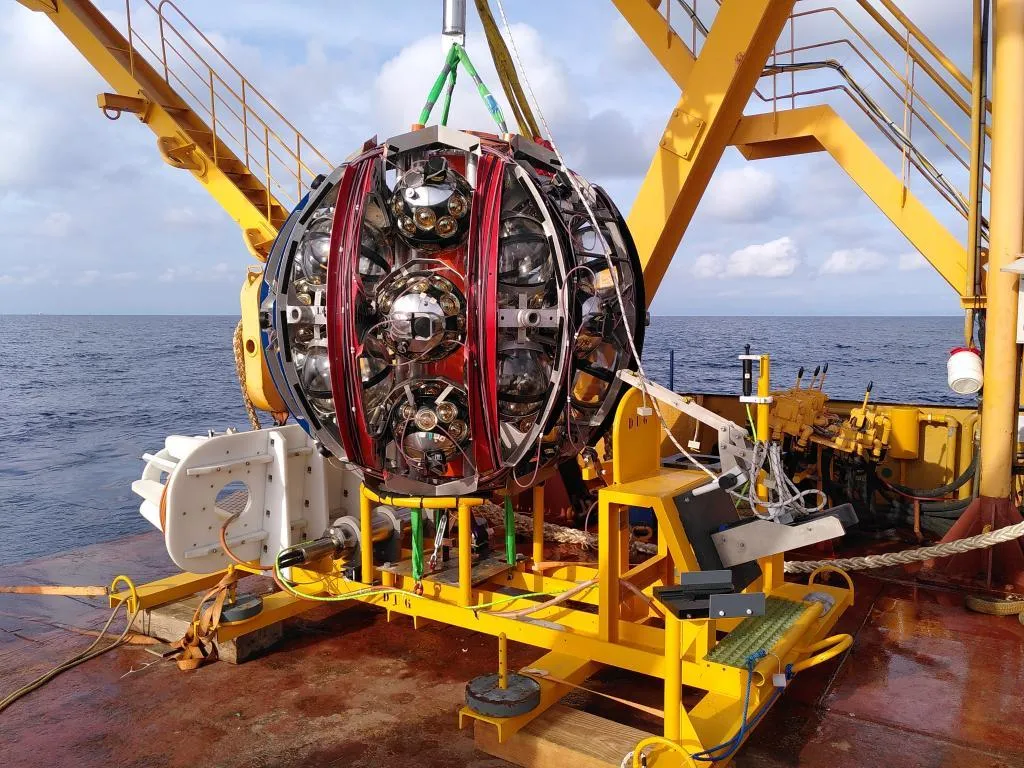
KM3NeT-detector. Credits Nikhef
NWO-I
Institutes Organisation of NWO

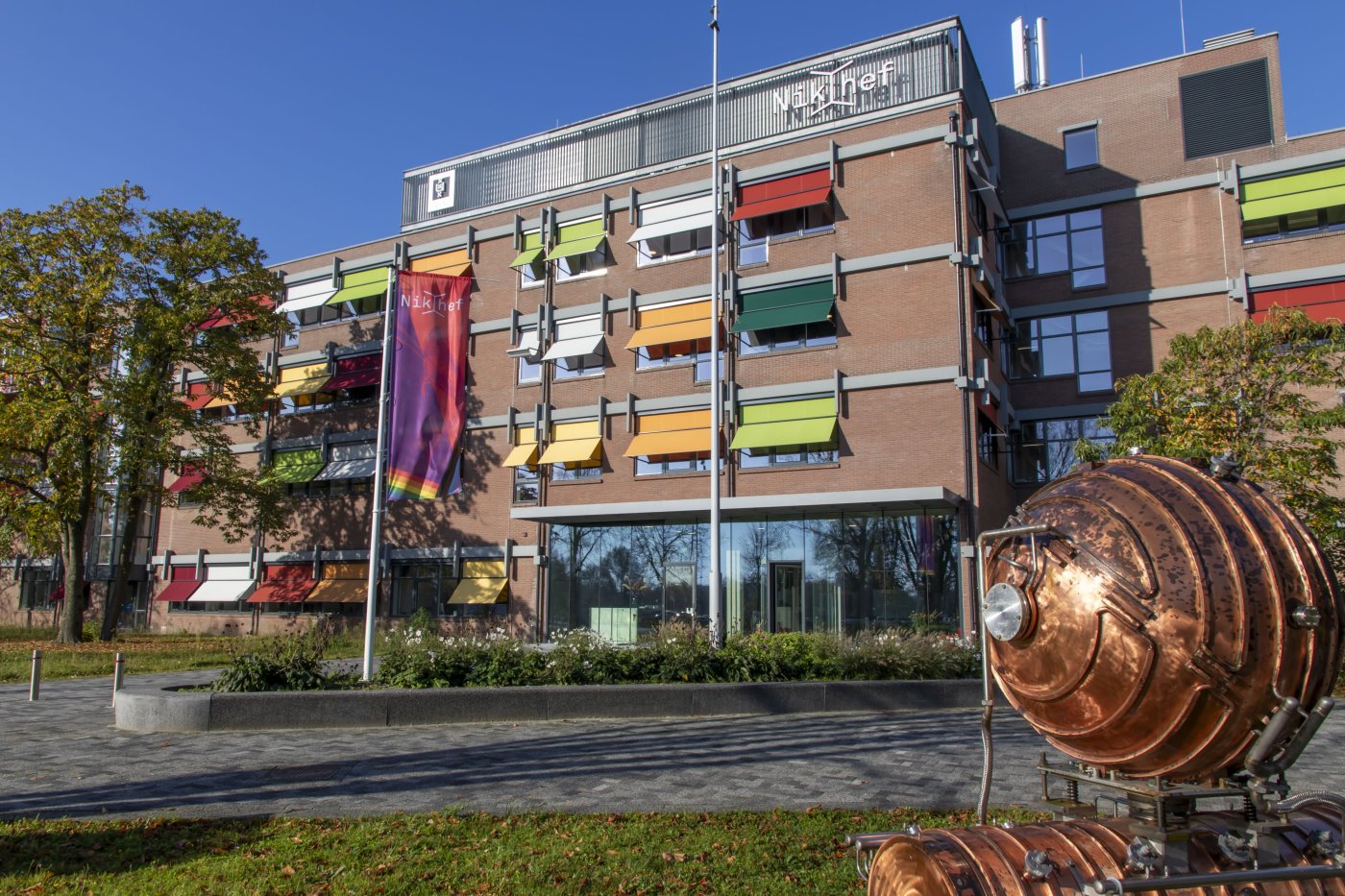
Nikhef conducts research into subatomic physics: the fundamental building blocks of our universe, the forces acting between them, and the structure of space and time. In this way, it seeks to answer the major questions in physics today.
Nikhef’s research focuses on particle physics and astroparticle physics. In these branches of physics, scientists study elementary particles. Particle research constantly demands the very best of science and technology, and collaboration between researchers and technical departments is essential. Nikhef has large technical departments and workshops specialising in mechanical technologu, electronics technology, and computer and network technology, all of which are involved in the experiments.
In particle physics, elementary particles are studied using very large detectors. Particles such as protons are accelerated in a particle accelerator and made to collide with one another. The detectors record these collisions, which release a great deal of energy to form other new particles, in accordance with Einstein’s E=mc². In essence, a detector is a microscope, and the smaller the scale we wish to observe, the larger the microscope and its lenses must be. Nikhef conducts its particle physics research at the Large Hadron Collider (LHC) at CERN.
Astroparticle physics brings together physics and astronomy. In the cosmos, extremely strong magnetic fields act, as it were, as a ‘natural’ particle accelerator. For this research, this means that ‘all’ that is needed is to build the right detectors to carry out the research. This is what the astroparticle physicists at Nikhef are working on. Nikhef’s research takes place within the KM3NeT, XENON, Auger and Virgo research partnerships.
Nikhef is a partnership between the Dutch Research Council (NWO) and six universities: Maastricht University, Radboud University, University of Amsterdam, University of Groningen, Utrecht University and VU Amsterdam.
Prof. dr. Jorgen D’Hondt
Nikhef
PO Box 41882, 1009 DB Amsterdam
Science Park 105, 1098 XG Amsterdam
+31 20 592 20 00
info@nikhef.nl