Afbeelding
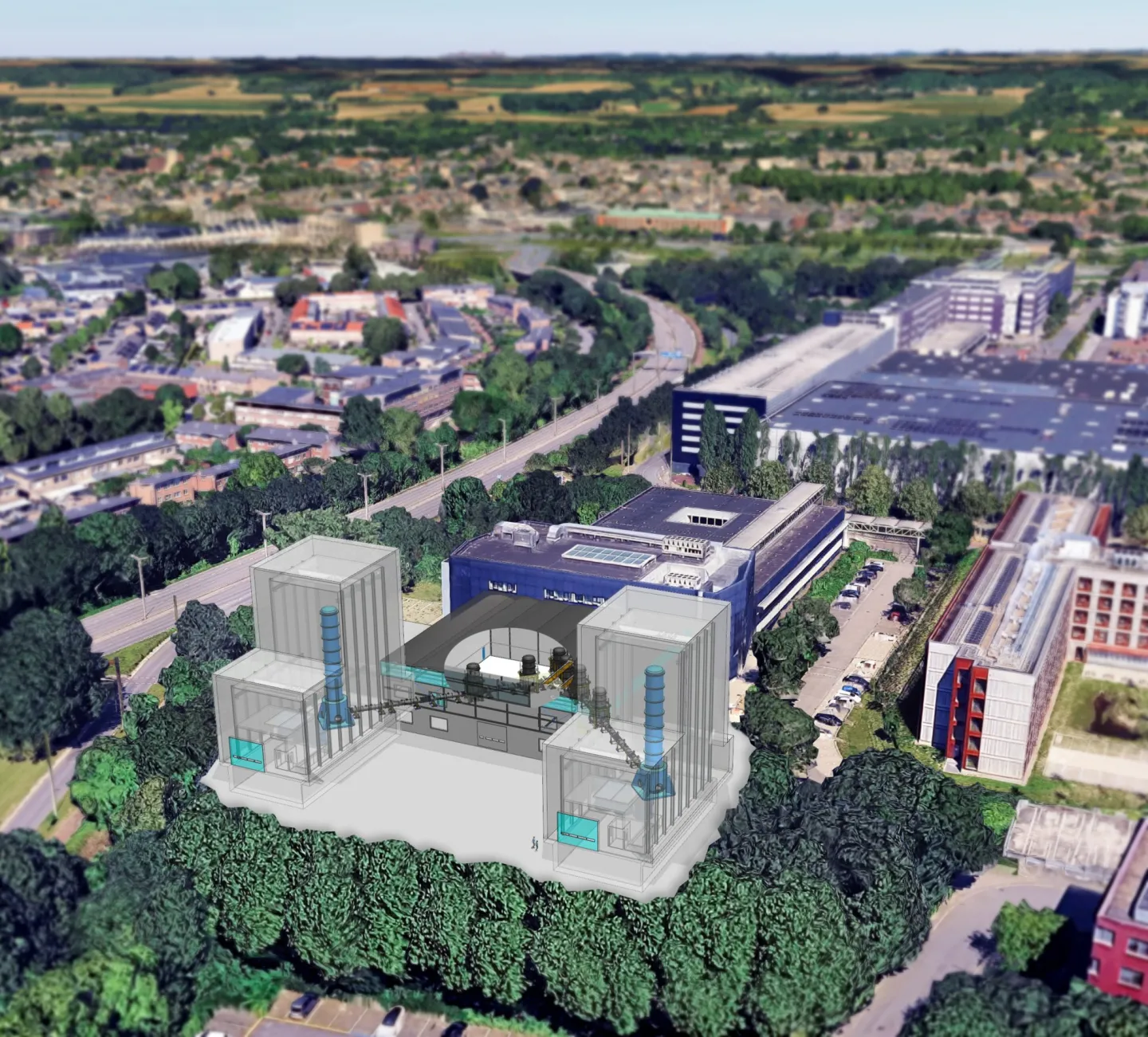
A rendering of the expansion of ETPathfinder into the ET-LFC facility in Maastricht. Credits Nikhef
NWO-I
Institutes Organisation of NWO

With the award of 25 million euros, ETPathfinder will undergo an expansion that will allow components and systems of the future Einstein Telescope to be tested at full scale and above ground.
The Dutch government is allocating 25 million euros for the proposed expansion of ETPathfinder in Maastricht. The expansion aims to transform the existing gravitational wave detection research facility in Limburg into a center for technology validation, integration, and training in Europe.
The additional government funding is outlined in the policy letter from the Ministry of Education, Culture, and Science, which was approved by the Cabinet on Friday. With this decision, ETPathfinder will undergo an expansion that will allow components and systems of the future Einstein Telescope to be tested at full scale and above ground.
The plans for the Einstein Telescope Low-Frequency Center (ET-LFC) call for the addition of two new high-cleanrooms adjacent to the existing ETPathfinder hall. The new halls will house optical, cryogenic, vacuum, and suspension systems at the scale required for the final Einstein Telescope, which will be connected to the Pathfinder.
I am extremely pleased that with the new center, we can now build a unique, central European research infrastructure - Jorgen D'Hondt, Nikhef Director
ETPathfinder, a project lead jointly by Nikhef and Maastricht University, is an R&D infrastructure for testing and developing innovative concepts and techniques for the Einstein Telescope. More than 20 institutions from eight countries are collaborating at the ET Pathfinder facility in Maastricht.
Nikhef Director Jorgen D’Hondt welcomes the government’s support. “The technology we need to peer deep into the universe with the Einstein Telescope has yet to be developed. This can only be achieved through strong international collaboration, for which we, as the national institute Nikhef, are taking the lead. I am extremely pleased that with the new center, we can now build a unique, central European research infrastructure that will play a key role in this.”
ETPathfinder Research Leader Stefan Hild calls the support for an expanded R&D facility a dream come true. “We are absolutely delighted to be able to expand ET Pathfinder. The addition of two full-scale mirror towers offers the opportunity to validate the crucial elements of ET together with partners from across Europe—down to a sensitivity of one-hundredth the size of a proton.”
The Einstein Telescope is a proposed new detector for detecting gravitational waves from the universe. The facility measures the distances between stationary mirrors in tunnels to detect ripples in space itself.
These ripples are caused by violent collisions of black holes or neutron stars in the universe. These vibrations can be used to study the origin and evolution of the universe.
Gravitational waves are generated by extremely violent events in the universe but have an extremely small effect on Earth. Their existence was predicted a century ago, but they were first actually detected in 2015.
The Einstein Telescope is a much more sensitive version of existing gravitational wave detectors in the US, Europe, and Japan. To achieve this, the facility will be much larger, with kilometer-long arms, and built in deep underground tunnels to avoid disturbances.
In addition, lasers with longer wavelengths will be used, and some mirrors will be cooled to extremely low temperatures. The necessary technologies for this are still under development.
For the Einstein Telescope, new technologies for the measurement system are already being developed at numerous locations across Europe, which will ultimately be integrated into the telescope. The expansion of ET Pathfinder will facilitate this integration.
The aim is to make the construction of the ET observatory faster and more cost-effective.
The Netherlands previously expressed its support for the construction of the Einstein Telescope. A plan is being prepared for construction in the Meuse-Rhine Euregio south of Maastricht. The National Growth Fund had previously committed 42 million euros as a start-up grant, with a reserve of 870 million euros for actual construction.
The National Institute for Subatomic Physics (Nikhef) is one of the initiators of the Einstein Telescope. Nikhef is a collaboration between NWO and six universities and is closely involved in research on gravitational waves, including the Virgo detector in Italy and the LIGO detectors in the U.S.
The ministry’s funding for the plan comes on top of the Province of Limburg’s intention to invest 4 million euros in the architectural preparations for the expansion. A formal decision on this is expected in May.
You can find more information about the Einstein Telescope on this website.