Afbeelding
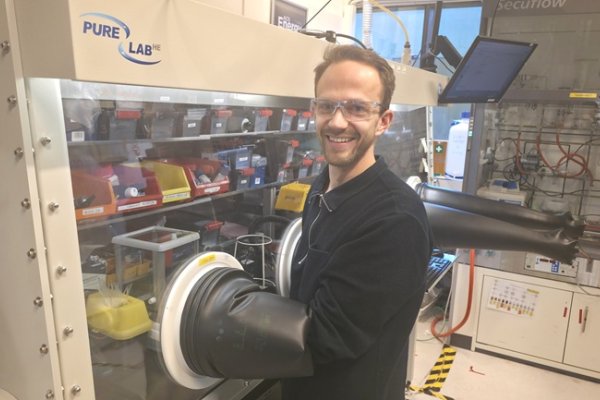
Researcher Moritz Schmidt in the Hybrid Solar Cells lab. Credits AMOLF
NWO-I
Institutes Organisation of NWO

AMOLF researchers in the Hybrid Solar Cells group developed a method for studying mobile ions (charged atoms) in perovskite solar cells.
Perovskite is a promising material for solar cells and could play a part in the energy transition. One of the obstacles to successful implementation is that the mobile ions in perovskite slowly corrode the material from within.
Mobile ions are difficult to study. Inspired by the behaviour of freezing water, the research team introduced a new and intuitive approach. When water freezes, it stops moving. In a similar way, the movement of mobile ions ceases in a cooling solar cell.
Researcher Moritz Schmidt: “Before it freezes, we push all the ions to one side of the solar cell. As the material heats up, the ions start to flow again, just like water in melting ice. Because the ions are charged, a measurable voltage is generated.” The new method thus shows how many mobile ions there are and how strong the voltage between them is.

Would you like to find out more about AMOLF's research?
Take a look at the AMOLF institute page