NWO-I

Institutes Organisation of NWO

Research at NWO-I

Our institutes conduct fundamental scientific research and have knowledge and expertise in the natural sciences, engineering sciences and social sciences. Our scientists are driven by curiosity and seek solutions to major societal challenges, such as climate change and the energy transition.

Dutch satellite instrument SPEXone produces world map of particulate matter

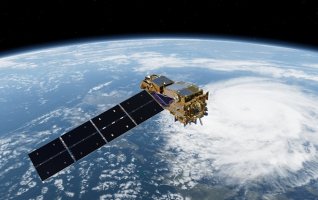
In early 2024, NASA launched climate satellite PACE with on board the Dutch aerosol instrument SPEXone, co-developed by SRON.

Afbeelding
PACE climate satellite. Credits: NASA GSFC

Dark matter experiment XENONnT measures solar neutrinos

XENONnT, a detector built to search for dark matter, has measured signals from solar neutrinos.

Afbeelding
Installation of the TPC, the part in the centre of the detector that comprises the active xenon volume of the experiment. Credits: XENON collaboration

E-value makes statistical testing more flexible and robust

The e-value not only makes experiments more flexible, and also allows the level of significance to be adjusted afterwards without compromising reliability.

Afbeelding
1e and p-value

New topological metamaterial amplifies sound waves exponentially

AMOLF researchers, together with partners from Germany, Switzerland and Austria, have developed a new metamaterial that is the first example of a so-called ‘bosonic Kitaev chain’.

Afbeelding
Artist’s impression of the ‘bosonic Kitaev chain’. Credits: Ella Maru Studio

Simple model captures complex plasma behaviour

ARCNL researchers in the Source Department discovered that a relatively simple, universal power law determines the complex behaviour of an expanding plasma of highly charged ions.

Afbeelding
AI-generated impression of simple universal model capturing complex plasma behaviour. Credits: ARCNL

LOFAR discovers largest black hole jets ever seen

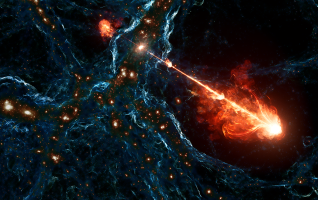
The LOFAR radio telescope has found the largest pair of eruptions ever observed shooting from a supermassive black hole.

Afbeelding
An illustration of the largest black hole jets ever observed. These eruptions, named Porphyrion after the mythological Greek giant, span roughly 23 million light years. They were observed using the LOFAR radio telescope.

Capturing CO2 from the air using sunlight

How can you capture CO2 from the air with the help of sunlight and store it efficiently? DIFFER and Toyota are collaborating on a reactor that can do just that.

Afbeelding
DIFFER made a prototype of the CO2 ‘capturing device’ for valorisation studies in collaboration with Toyota Motor Europe. Credits: DIFFER/Bart van Overbeeke