Afbeelding
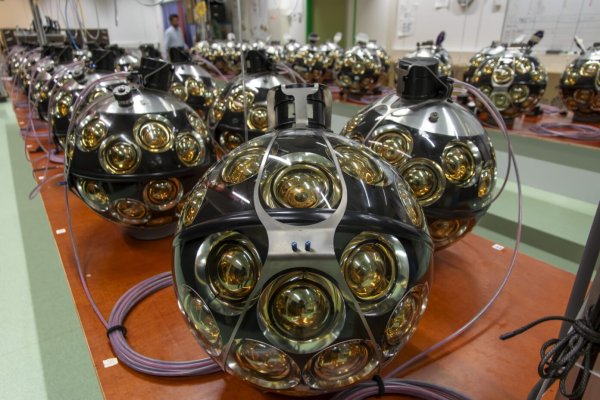
KM3NeT detector. Credits Nikhef
NWO-I
Institutes Organisation of NWO

The Netherlands, through NWO institute Nikhef, is helping build the large KM3NeT neutrino detector at the bottom of the Mediterranean Sea near Toulon and Sicily. The detector, largely designed in the Netherlands, is intended to capture passing ‘ghost particles’. The detector's components are assembled in series at Amsterdam Science Park.
The KM3NeT detector is an instrument capable of registering the passage of neutrinos (‘ghost particles’). The detector is being built at two sites in the Mediterranean Sea. The giant observatory, comprised of hundreds of lines equipped with light sensors, monitors flashes of light in a total volume of one cubic kilometre of dark, deep‑sea water. Traces of neutrinos can be reconstructed from the light signals captured by the sensor network. KM3NeT studies both potential neutrino sources in the sky and the physical properties of the neutrinos themselves.
Neutrinos are the most elusive of all known particles in the Standard Model. These ghost particles are a by-product of nuclear processes but barely interact with matter afterwards. They remain poorly understood and may help answer major open questions in particle physics, such as the puzzling absence of antimatter in the universe.
Nikhef is one of the main partners in the international KM3NeT project. Dutch researchers and engineers designed key elements of the neutrino telescope, including the glass spheres with light sensors that can withstand deep-sea conditions, as well as the system’s power and data network. Nikhef also developed the deployment reels and procedures used to lower detector lines from lifting vessels at sea. The deployment is led by France and Italy at the two KM3NeT sites: ORCA, near Toulon, at a depth of 2 kilometres, and ARCA, near Sicily, at a depth of 3 kilometres.
The construction of KM3NeT is a long‑term effort that will not be completed until the 2030s. Around one‑third of the detector has been completed so far. Even during its construction, the steadily expanding detector is already collecting data. In 2023, KM3NeT recorded the impact of the most energetic neutrino ever observed, with tens of thousands of times more energy than particle accelerators on Earth can produce.
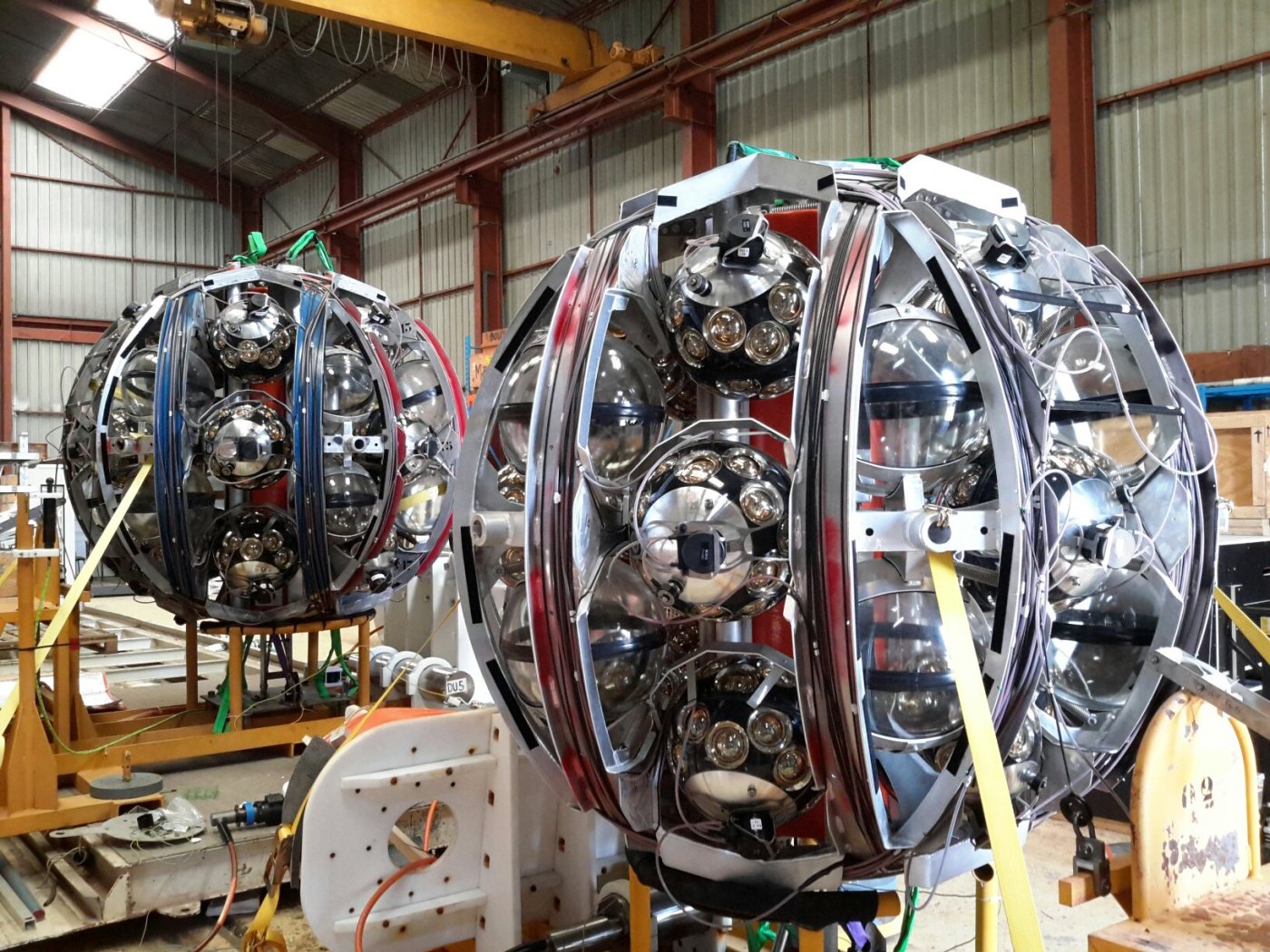
NWO institute Nikhef is one of the main partners in KM3NeT. Dutch researchers hold key leadership roles within the organisation, which comprises dozens of countries and institutes working on construction and data analysis. A substantial share of the detector modules for KM3NeT‑ORCA is assembled and tested at Amsterdam Science Park before being deployed at sea in southern Europe.
KM3NeT is partially funded by numerous significant Dutch contributions, including through Roadmap programmes for scientific infrastructure.
Would you like to find out more about KM3NeT, its research and on-site facilities? Then visit the KM3NeT website. You can find more information about the institute Nikhef on the Nikhef website.