NWO-I

Institutes Organisation of NWO

Research infrastructures

The NWO institutes have state-of-the-art large-scale research facilities at their disposal. They are also part of major national and international partnerships with renowned facilities.

National facilities and collaborations

Some of our institutes have (large-scale) research facilities on site. These range from magnets and lasers to the national research fleet for marine research. The facilities are used by scientists from NWO-I and are, in many cases, open to external researchers.

Afbeelding
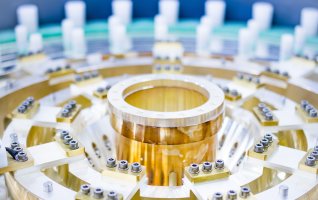
Oranje rond onderdeel van de HFML-FELIX faciliteit

HFML-FELIX facilities

Facility with some of the world's strongest magnets and free‑electron lasers that produce an unprecedented range of infrared light.

Afbeelding
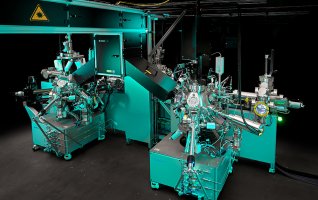
PLD4Energy: a thin-film deposition and characterisation facility

Magnum-PSI, Ion Beam & PLD4Energy

DIFFER has several unique research facilities that allow researchers to study materials for the energy transition.

Afbeelding
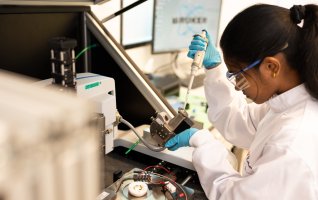
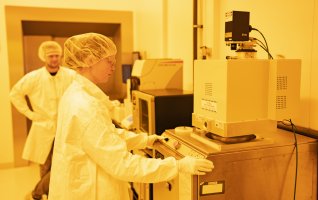
AMOLF NanoLab researchers. Photography by Ivar Pel

NanoLab

Cleanroom with facilities for microscopy, electron microscopy, various lithography methods, plasma etching, material deposition and material analysis.

Afbeelding
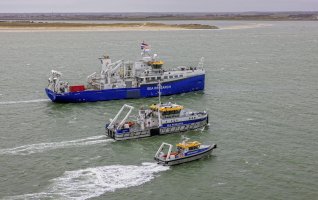
The three vessels of the national research fleet from NIOZ are sailing side by side in the Wadden Sea

National research fleet

The fleet consists of three state-of-the-art vessels equipped with advanced research instrumentation.

Afbeelding

Secure Analytics lab

NSCR established a specially designed, highly secure working environment for research involving sensitive data sets.

Afbeelding
AMOLF researcher Daphne Antony in the 3D Photovoltaics research lab

SolarLab

The SolarLab consortium researches new solar energy technologies from six main locations and three satellite sites.

International facilities and collaborations

Some of our institutes are part of international partnerships centred around large-scale research facilities, such as CERN in Switzerland or SKAO in Australia, South Africa and the United Kingdom.

Afbeelding
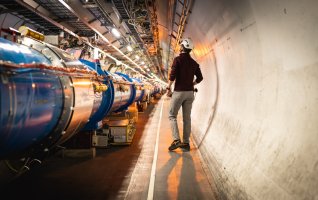
Man with white helmets walks near blue pipe at CERN

CERN Particle Accelerator

The Netherlands has been involved in major experiments using the LHC particle accelerator ever since CERN was founded.

Afbeelding
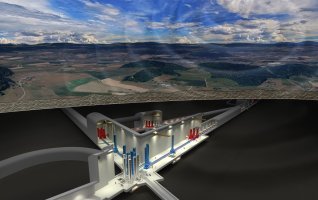
An impression of the Einstein Telescope

Einstein Telescope

A proposed infrastructure featuring kilometres-long underground ‘arms’ that can detect gravitational waves in detail.

Afbeelding
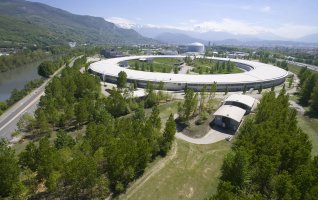
Wit donutvormig gebouw in het landschap van Grenoble in Frankrijk

ESRF-EBS

The European Synchrotron Radiation Facility is home to the world's first fourth-generation high-energy synchrotron light source.

Afbeelding
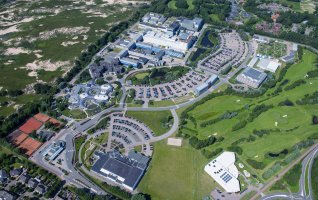
The ESTEC building in Noordwijk, seen from above

ESTEC-ESA

The European Space and Technology Centre is the technical heart of the European Space Agency.

Afbeelding
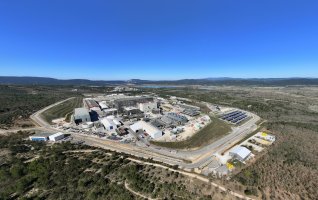
Aerial photo of ITER with buildings under construction

ITER

The International Thermonuclear Experimental Reactor is the first fusion reactor for research into stable nuclear fusion on a commercial scale.

Afbeelding
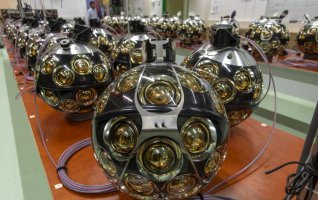
A detector sphere from the KM3NeT measuring instrument

KM3NeT: neutrino detector at sea

This large neutrino detector, designed to capture passing 'ghost particles', is currently under construction at the bottom of the Mediterranean Sea.

Afbeelding

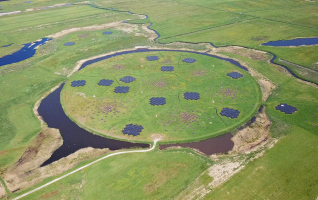
LOFAR

The Low Frequency Array is currently the largest radio telescope in the world that operates on the lowest frequencies that can be observed from Earth.

Afbeelding
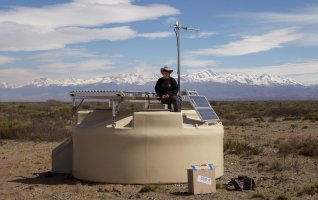
Pierre Auger Observatory

Pierre Auger Observatory

Facility for cosmic ray research in the Argentine Pampas.

Afbeelding
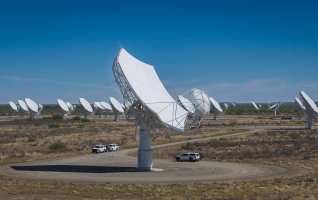
Aerial photo of radiotelescopes in South Africa

SKAO

De Square Kilometre Array Observatory will be the most powerful radio telescope in the world.

Afbeelding
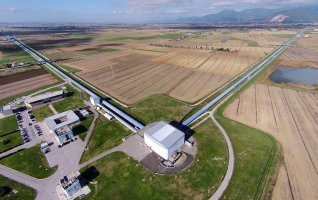
The Virgo gravitational wave detector, viewed from above

Virgo gravitational-wave detector

Gravitational-wave dectector at the European Gravitational Observatory in Italy.

Afbeelding
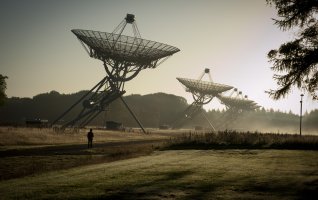
Radio telescopes with a person in the foreground

WSRT-EVN

A powerful radio telescope at Westerbork and part of the European Very Long Baseline Interferometry Network (EVN).

Afbeelding
Logo BigScience.nl

BigScience.NL

Various scientific research institutes in the Netherlands either operate large-scale research facilities themselves or are partners in (international) collaborations centred around large-scale scientific research infrastructures. Research conducted using or within these large-scale scientific research infrastructures is also referred to as Big Science. The Dutch institutes involved in Big Science are united under BigScience.NL.
Read more about BigScience.nl