Afbeelding

Photo ASTRON
NWO-I
Institutes Organisation of NWO

LOFAR (LOw Frequency ARray) is currently the largest radio telescope operating at the lowest frequencies that can be observed from Earth. It consists of a network of 52 measurement stations distributed across Europe. LOFAR allows researchers to look back billions of years in cosmic history, to when the first galaxies were forming. LOFAR was conceived and built at NWO institute ASTRON in Dwingeloo.
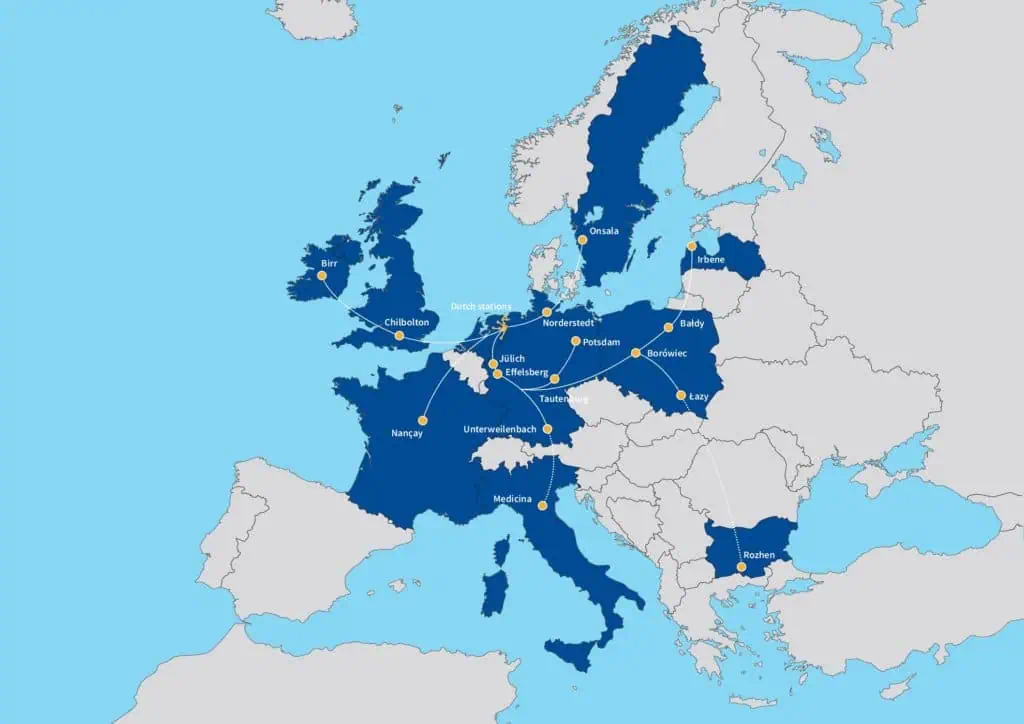
LOFAR is a radio telescope comprised of an array of receivers that capture radio signals at specific low frequencies. The project began as a national initiative at ASTRON in 2010. Since 2012, the International LOFAR Telescope has consisted of a network of 52 stations spread across nine countries. Thirty‑eight of these stations are located in the northeast of the Netherlands. Additional stations are situated in Germany, France, Sweden, the United Kingdom, Poland, Latvia and Ireland, with new stations being built in Italy and Bulgaria in the next two years. The enormous range of distances between the stations yields unique capabilities for detailed images of the sky.
LOFAR allows researchers to look back billions of years in cosmic history to when the first stars and galaxies were formed (the ‘Cosmic Dawn’). They can scan vast regions of the low‑frequency radio sky, continuously searching for the most energetic and explosive events in the universe.
Thanks to LOFAR’s revolutionary ability to ‘look’ in multiple directions at once, astronomers can conduct multiple studies simultaneously.
NWO institute ASTRON coordinates the operation of the telescope. In 2023, the European Commission designated LOFAR a European Research Infrastructure Consortium (ERIC). The Netherlands is the host country for this ERIC, which is based at ASTRON.
Would you like to find out more about LOFAR, its research and on-site facilities? Then visit the LOFAR ERIC website. You can find more information about the institute ASTRON on the ASTRON website.