Afbeelding
Pierre Auger Observatory
NWO-I
Institutes Organisation of NWO

NWO institute Nikhef coordinates the Dutch contribution to the Pierre Auger Observatory for cosmic rays in Argentina, where significant new additions have been implemented to advance the search for cosmic particles and their accelerators.
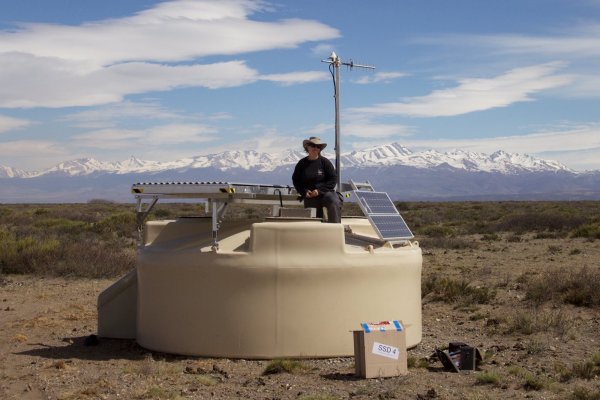
As part of a research group at Radboud University in Nijmegen, Nikhef is closely involved in the Pierre Auger Observatory for cosmic rays in the remote pampas of Argentina. Scattered over an area of 3000 square kilometres, more than 1,600 water tanks equipped with sensors are used to detect incoming particles. Radio antennas mounted on the tanks capture electromagnetic signals from atmospheric particle showers. Twenty-five telescopes along the perimeter of the observatory detect ultraviolet light from the particle showers in the dark night sky.
Many violent astrophysical processes in the universe release particles that often reach Earth with immense energy. Upon collision with the atmosphere, these particles create cascades of charged particles known as cosmic rays. When these cascades of particles reach Earth’s surface, they can be detected with sensors. By analysing these signals, researchers can determine the energy of the incoming particles and trace their direction back to their source in the night sky.
Low-energy particles are known to drift through the Milky Way like a gas; they are often remnants of burnt-out stars after supernovae. These particles are also very abundant. In contrast, the ultra-high-energy particles studied by the Pierre Auger Observatory are much rarer; they have energies more than 100 million times higher than those achievable in Earth-based particle accelerators, which may offer insight into new physics.
By precisely measuring the properties of these particle showers, researchers can determine the origin and energy of the cosmic rays. They also investigate the mass of the original cosmic rays: are they as light as hydrogen, as heavy as iron, or somewhere in between? New scintillators and radio detectors are key to these studies.
By comparing the arrival directions of high-energy cosmic rays with the positions of known celestial objects (e.g., black holes, galaxies, and supernovae), researchers aim to discover the true sources of these cosmic rays.
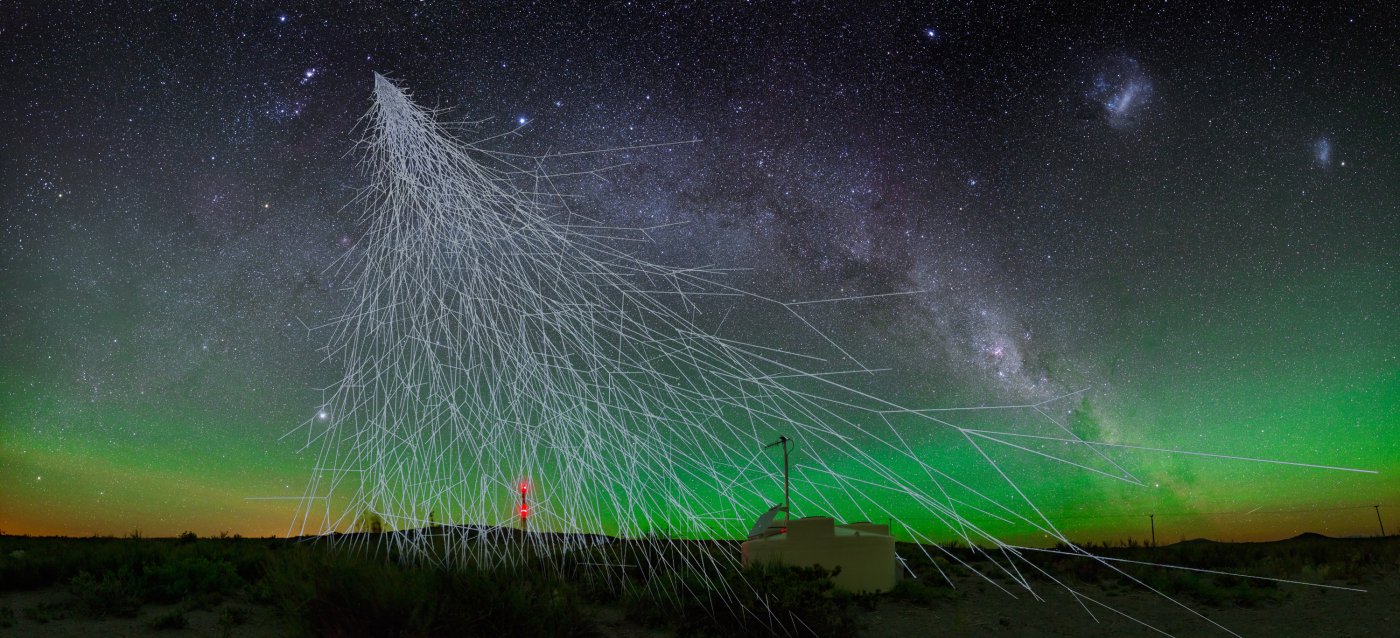
The Pierre Auger Collaboration includes scientists from seventeen countries, including the Netherlands. Nikhef coordinates the Dutch contribution through its partner, Radboud University in Nijmegen. Together with international colleagues, Nikhef scientists have developed antennas for the observatory to study the radio signals generated by the interaction of particle showers with Earth’s magnetic field and atmosphere. Nikhef was also significantly involved in the design, production, and installation of the new thin scintillation detector for Auger. In addition, Nikhef plays a leading role in analysing the resulting data.
Would you like to find out more about the Pierre Auger Observatory, its research and on-site facilities? Then visit the Pierre Auger-website. You can find more information about the institute Nikhef on the Nikhef website.