Afbeelding
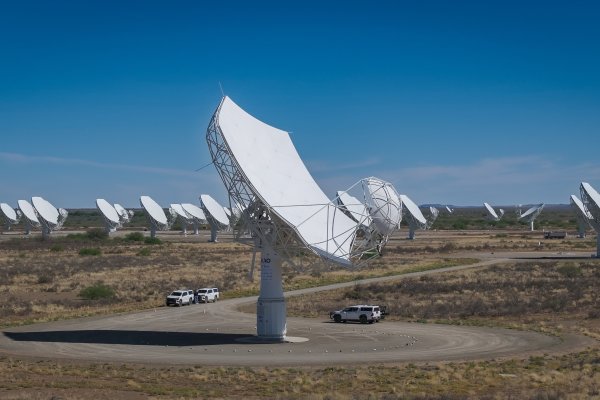
An SKA-Mid dish, with MeerKAT dishes in the background. Credits SKAO, September 2025
NWO-I
Institutes Organisation of NWO

The SKAO (Square Kilometre Array Observatory) will be the most powerful radio telescope in the world. Spread across the remote deserts of South Africa and Australia, the telescope is being built from hundreds of antennas, and will generate unprecedented data volumes. NWO institute ASTRON represents the Netherlands in the collaborative partnership for the telescope.
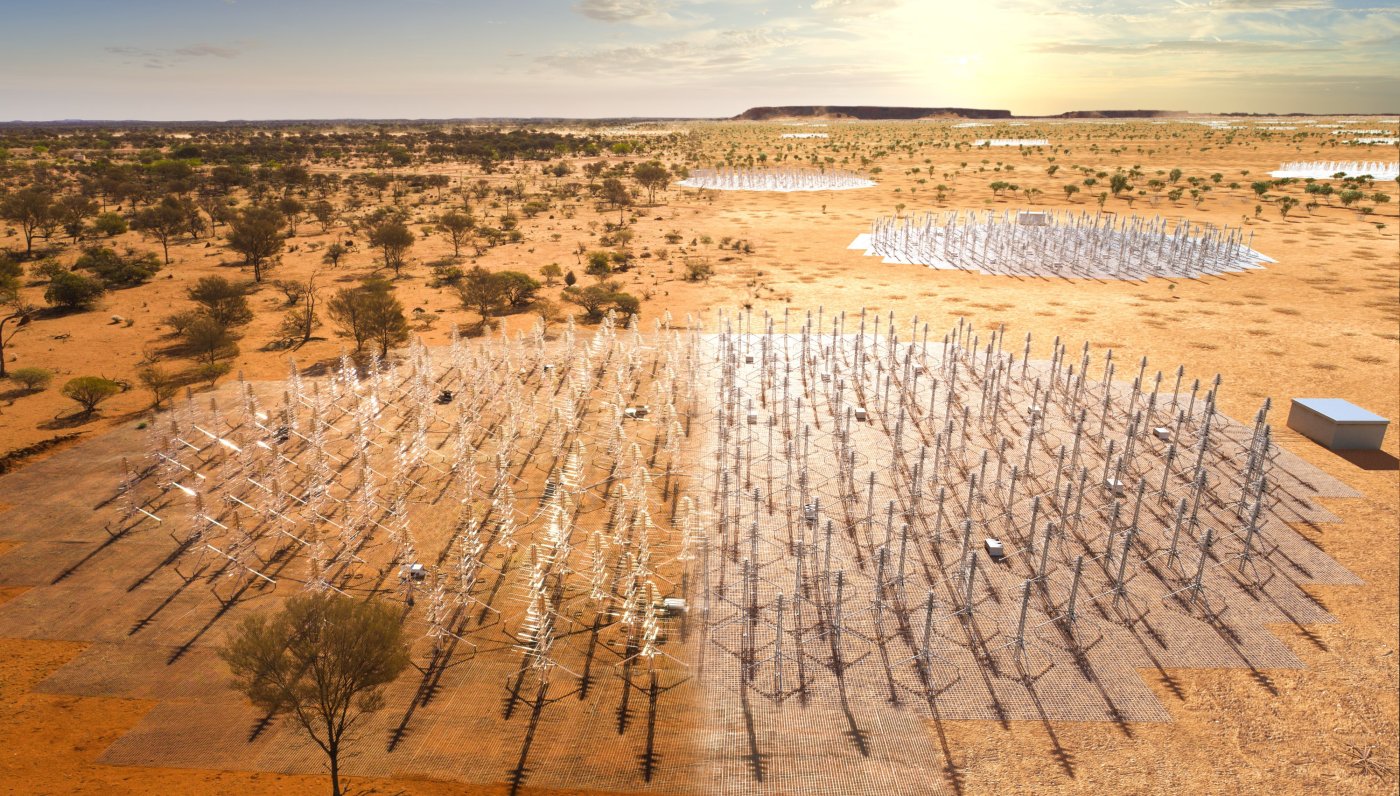
The SKAO consists of two telescopes: SKA-Low in Australia and SKA-Mid in South Africa. The telescopes observe the sky at different radio frequencies, complementing one another’s capabilities. The array has been under construction since 2022. Because the components operate independently, the first scientific results are expected in 2027. The SKAO is projected to be fully operational in 2028/2029.
By measuring with even greater precision across both low and high radio frequencies, the SKAO will be able to investigate fundamental themes in astrophysics—from 100 million years after the Big Bang, when the first stars began to form (the ‘Cosmic Dawn’), to the present‑day universe dominated by dark energy and accelerating expansion.
The observatory will provide new insights into the formation and evolution of galaxies, quasars, supernovae, pulsars, fast radio bursts and many other cosmic phenomena. The new radio telescope will enable groundbreaking scientific research that will transform our understanding of the universe.
Astronomers at Dutch universities and at NWO institute ASTRON are conducting world‑class, groundbreaking research with the SKA precursors, LOFAR and WSRT‑APERTIF, developing the detailed expertise needed to fully exploit the SKA's scientific potential.
Building on the knowledge gained through LOFAR, ASTRON leads the consortium responsible for implementing the Aperture Array Verification System (AAVS1), a prototype SKA‑Low station installed near the SKA‑Low site in Western Australia.
The EMBRACE (Electronic Multibeam Radio Astronomy Concept) station near Westerbork in Drenthe was built as part of the SKA programme. It will serve as a test environment for new developments and for further validation of the key technologies to be deployed at the SKA‑Mid site in South Africa.
The SKAO will generate more data than has ever been processed and analysed before, which will require innovation in hardware, software and expertise. This, in turn, creates the need for a Science Data Centre (SDC) in the north of the Netherlands, supported through a public‑private partnership between science, government and the business community.
The SKAO is an intergovernmental organisation established by 12 countries worldwide. The observatory has a global reach, with its headquarters located in the United Kingdom. The Dutch Ministry of Education, Culture and Science serves as the formal representative of the Netherlands on the Governing Board, while ASTRON represents the Dutch scientific community.
Would you like to find out more about SKAO, its research and on-site facilities? Then visit the SKAO website. You can find more information about the institute ASTRON on the ASTRON website.