Afbeelding

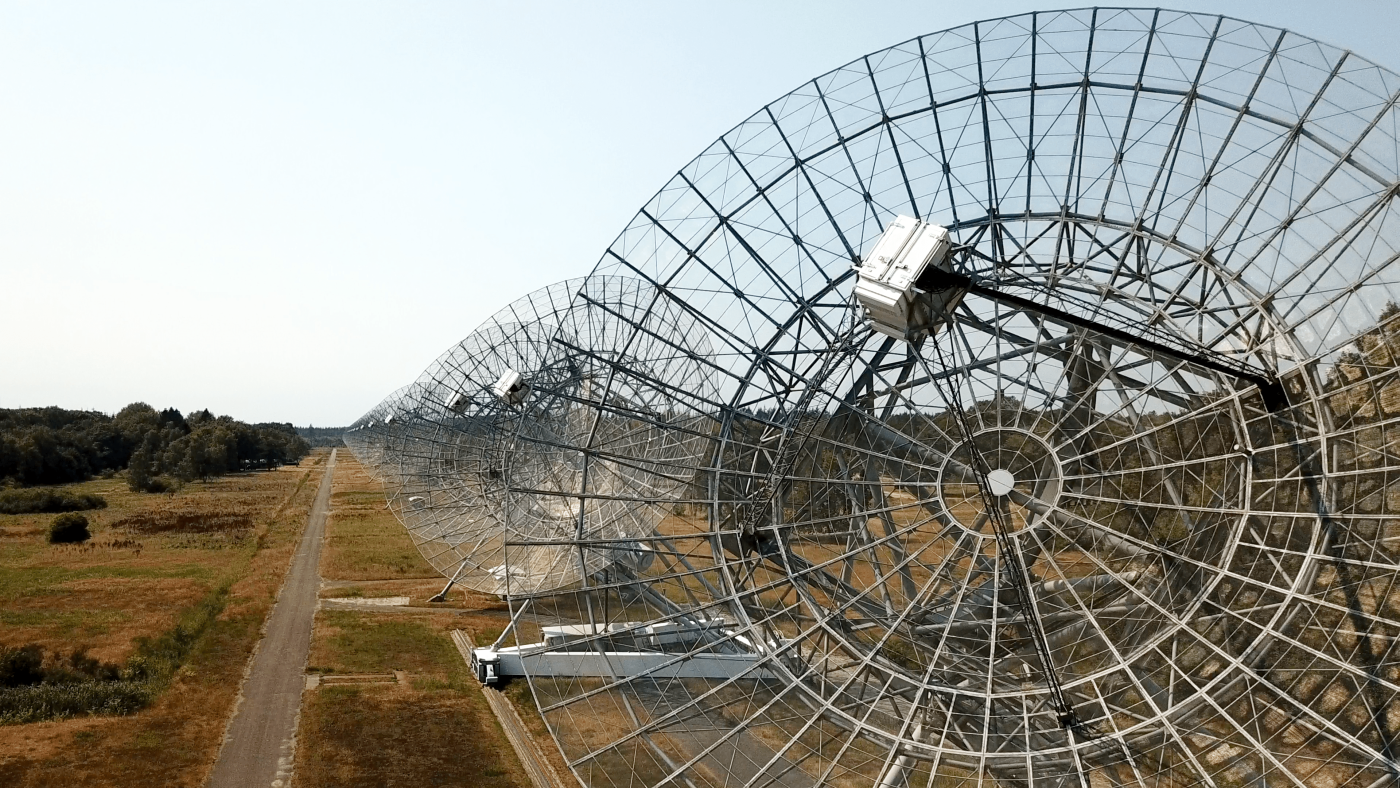
Westerbork Synthesis Radio Telescope (WSRT). Credits Harm-Jan Stiepels
NWO-I
Institutes Organisation of NWO

The Westerbork Synthesis Radio Telescope (WSRT) is a powerful radio telescope managed by NWO institute ASTRON. The telescope consists of fourteen 25-metre steerable dish antennas. The WSRT is an open research facility available to scientists worldwide and is part of the European Very Long Baseline Interferometry Network (EVN).
The Westerbork Radio Observatory consists of fourteen parabolic dish antennas, some of which are located on the grounds of the former Westerbork Transit Camp in Drenthe. The Westerbork Synthesis Radio Telescope was commissioned in 1970. To minimise interference, the use of mobile phones and other sources of radio-frequency interference (including cars) is prohibited throughout the surrounding area.
Ten of the dishes are in fixed locations, while two on the east side of the array can be moved along rails. A second pair of mobile dishes on rails is located 1.4 km farther east. Using radio synthesis techniques, the setup simulates a telescope with a 2.8-kilometre diameter.
In 1998, the first two dishes at Westerbork were equipped with the cryogenically cooled Multi-Frequency Front End (MFFE). These are used for Very Long Baseline Interferometry (VLBI)—collaboration with other telescopes and a satellite— making the WSRT part of the European VLBI network. This enables the WSRT to produce images so sharp that a football on the moon would be visible.
In 2018, APERTIF (APERture Tile In Focus) was installed on the remaining twelve WSRT dishes. APERTIF is an observation system that uses focal plane array technology to greatly increase the field of view and survey speed. This upgrade has enabled the dishes to provide scientific insights that are crucial to preparing for the Square Kilometre Array (SKA).
The European Very Long Baseline Interferometry network (EVN) is a collaboration among radio telescopes in 14 countries, forming the most sensitive VLBI array in the world and the only one capable of real‑time observations.
Researcher access to the EVN is based on open proposals. The Joint Institute for VLBI ERIC (JIVE) provides support for project proposals, planning, and coordination of EVN projects. JIVE is a European Research Infrastructure Consortium (ERIC) and is responsible for data processing and user services for the EVN. JIVE’s headquarters are located at NWO institute ASTRON in Dwingeloo. For more information about use and access, visit the EVN website.
Would you like to find out more about EVN, its research and on-site facilities at Westerbork? Then visit the EVN-website or the WSRT-page on the ASTRON-website. You can find more information about the institute ASTRON on the ASTRON website.