Afbeelding
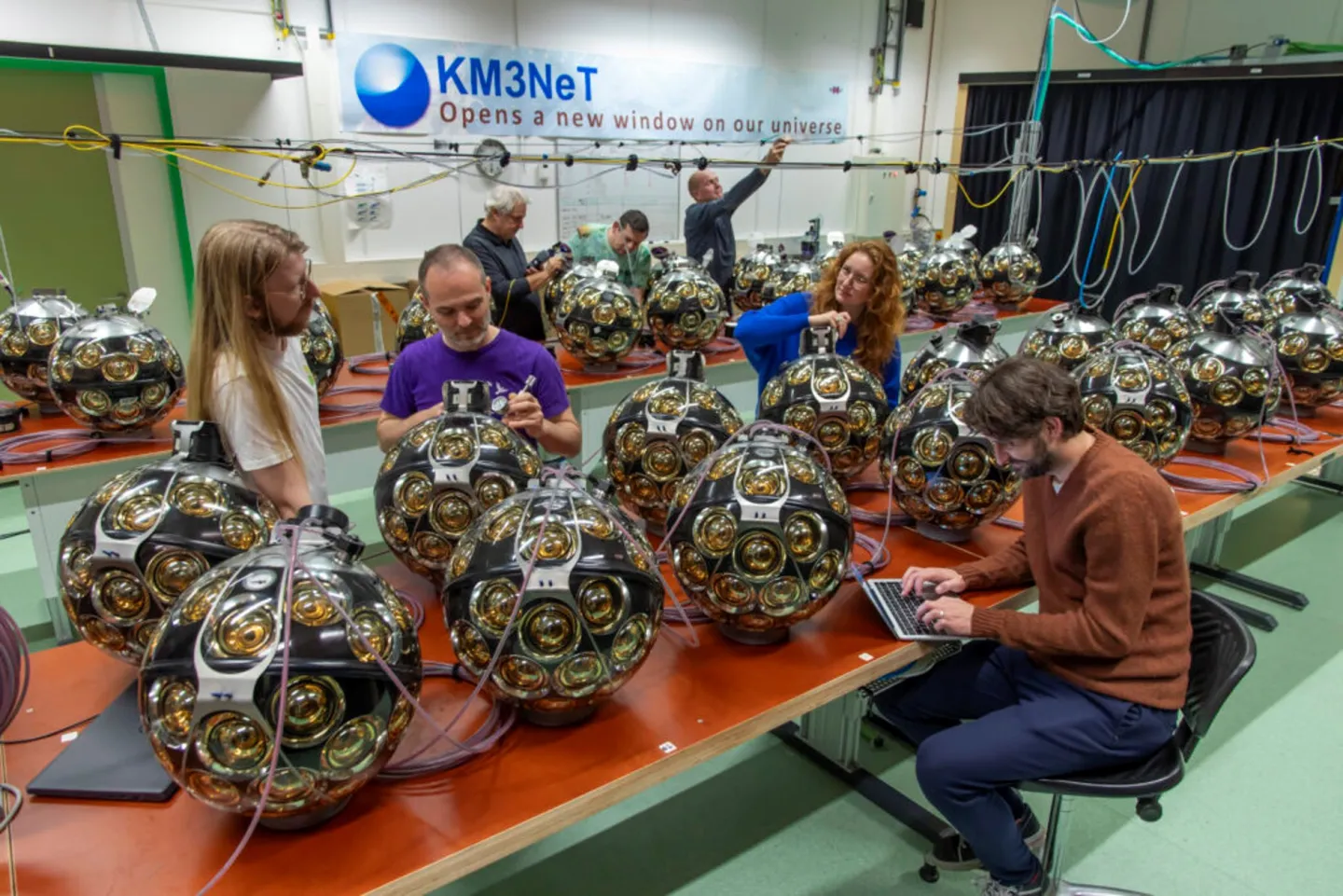
KM3NeT. Credits Nikhef
NWO-I
Institutes Organisation of NWO

The international KM3NeT project, which is building a neutrino telescope on the seafloor of the Mediterranean Sea, has been definitively recognized for the European ESFRI roadmap. Nikhef is a key partner in the KM3NeT collaboration.
Every ten years, the European Strategy Forum for Research Infrastructures (ESFRI) identifies which research facilities will shape European science over the next 10–20 years. With its current recognition as a so-called ‘landmark’, KM3NeT is becoming an integral part of European science policy. The recognition will be officially confirmed in early December.
KM3NeT will be a deep-sea detector that searches a cubic kilometre of dark water for light emitted when neutrinos from space strike it. The detector consists of several hundred spheres fitted with light sensors, upright suspended by cables on the seabed.
There are two sites, one in French waters and one in Italian waters. The telescope searches for sources of neutrinos and studies the properties of these barely detectable particles. You can find more information about KM3NeT on this website, under ‘International facilities and collarborations’.
KM3NeT had already been a candidate for recognition during two previous evaluation periods, and this was its final chance to secure the ‘landmark’ designation. The collaboration reacted with great delight to the final approval. The new ESFRI Roadmap will be officially announced at a meeting in Rome on 2 December.
The recognition marks the culmination of twenty years of work and preparation, according to a statement issued by KM3NeT this week. In 2006, the launch of the neutrino project was included in the ESFRI agenda.
In 2016, the project – which is now under construction at two sites in France and Italy – was re-included on the agenda. According to ESFRI, by 2026, KM3NeT will be building a unique deep-sea research infrastructure.
Nikhef is a key partner in the KM3NeT collaboration, playing leading roles in management and the scientific programmes. Many of the telescope’s subsea components have been designed by Nikhef. Some of the hardware is being manufactured at a facility in the Science Park in Amsterdam.
In its report, ESFRI praises how KM3NeT’s vision, mission and implementation are mature and ready to play a leading role in international neutrino physics. The project is described as complementary to observatories in China, Japan and the US.