Afbeelding
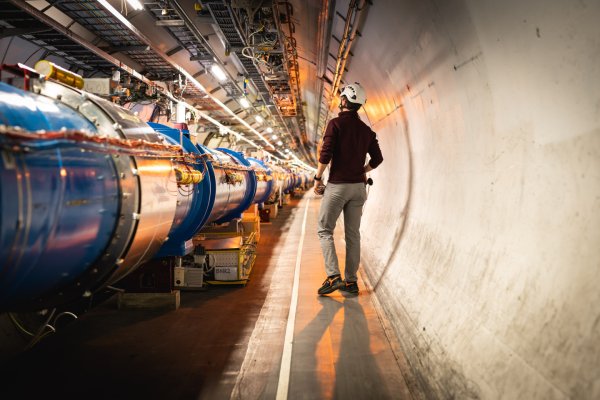
Particle accelerator at CERN. Credits CERN
NWO-I
Institutes Organisation of NWO

Since its founding, the Netherlands has been actively involved in major experiments at CERN in Geneva, particularly with the world’s largest particle accelerator, the Large Hadron Collider (LHC). NWO institute Nikhef coordinates and facilitates particle and astroparticle physics research in the Netherlands and represents the country in the CERN Council.
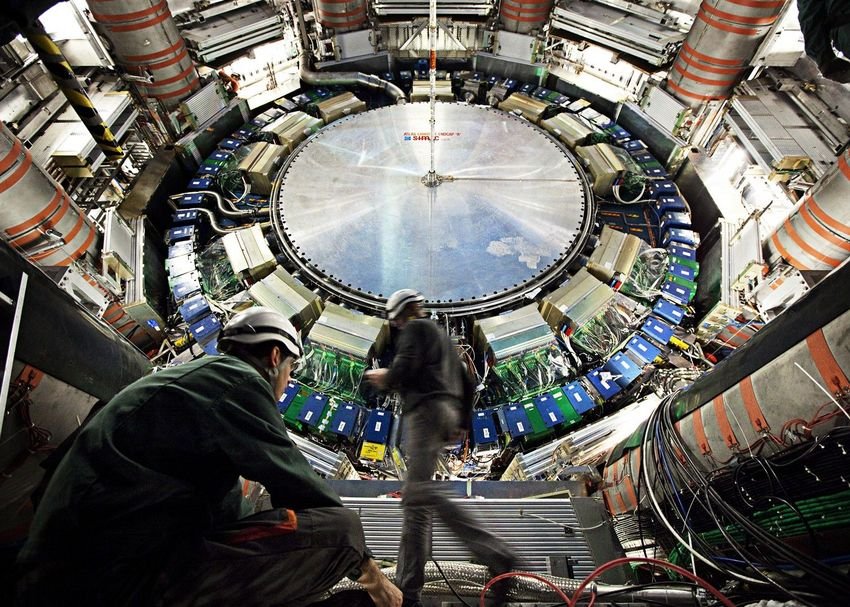
CERN operates the world’s largest and most powerful particle accelerator, the Large Hadron Collider (LHC), just outside Geneva. In this 27-kilometre underground circular accelerator, protons are fired at each other at almost the speed of light. Four large detectors positioned around the ring capture detailed images of the collisions, analysing the tracks and properties of the resulting particles. These measurements help test and refine our understanding of the fundamental particles and forces that govern the universe.
Nikhef is involved in three experiments at CERN, each with its own physics focus and scientific organisation, in which Nikhef researchers frequently occupy prominent positions.
These include the ALICE experiment, which focuses on studying quark-gluon plasmas, similar to the matter that existed shortly after the Big Bang. And the LHCb experiment, which investigates the subtle differences between matter and antimatter. Nikhef also plays a role in ATLAS, the world’s largest detector, designed for research into the Higgs boson and the search for new particles and forces. In 2012, the existence of the Higgs boson was demonstrated using this detector and the CMS detector at CERN. That particle is central to the theory explaining how elementary particles can have mass. The discovery earned a Nobel Prize in 2013.
Founded in 1954, CERN is a global collaboration in particle physics. The Netherlands is a founding member of the organisation, which now involves 25 member states. More than 12000 scientists are involved in the research.
Nikhef represents the Netherlands in the CERN Council—the organisation’s highest decision-making body—alongside a ministerial delegate. The Dutch Ministry of Education, Culture, and Science funds the annual membership contribution, which supports CERN’s maintenance and operations. Nikhef contributes personnel and also provides support through the development of new equipment and data processing systems.
Particle physics research constantly pushes the boundaries of science and technology, which requires close collaboration between researchers and technical teams. Nikhef has large technical departments and workshops specialised in mechanical technology, electronics technology, and computer and network technology.
Would you like to find out more about CERN, its research and on-site facilities? Then visit the CERN-website. You can find more information about the institute Nikhef on the Nikhef website.